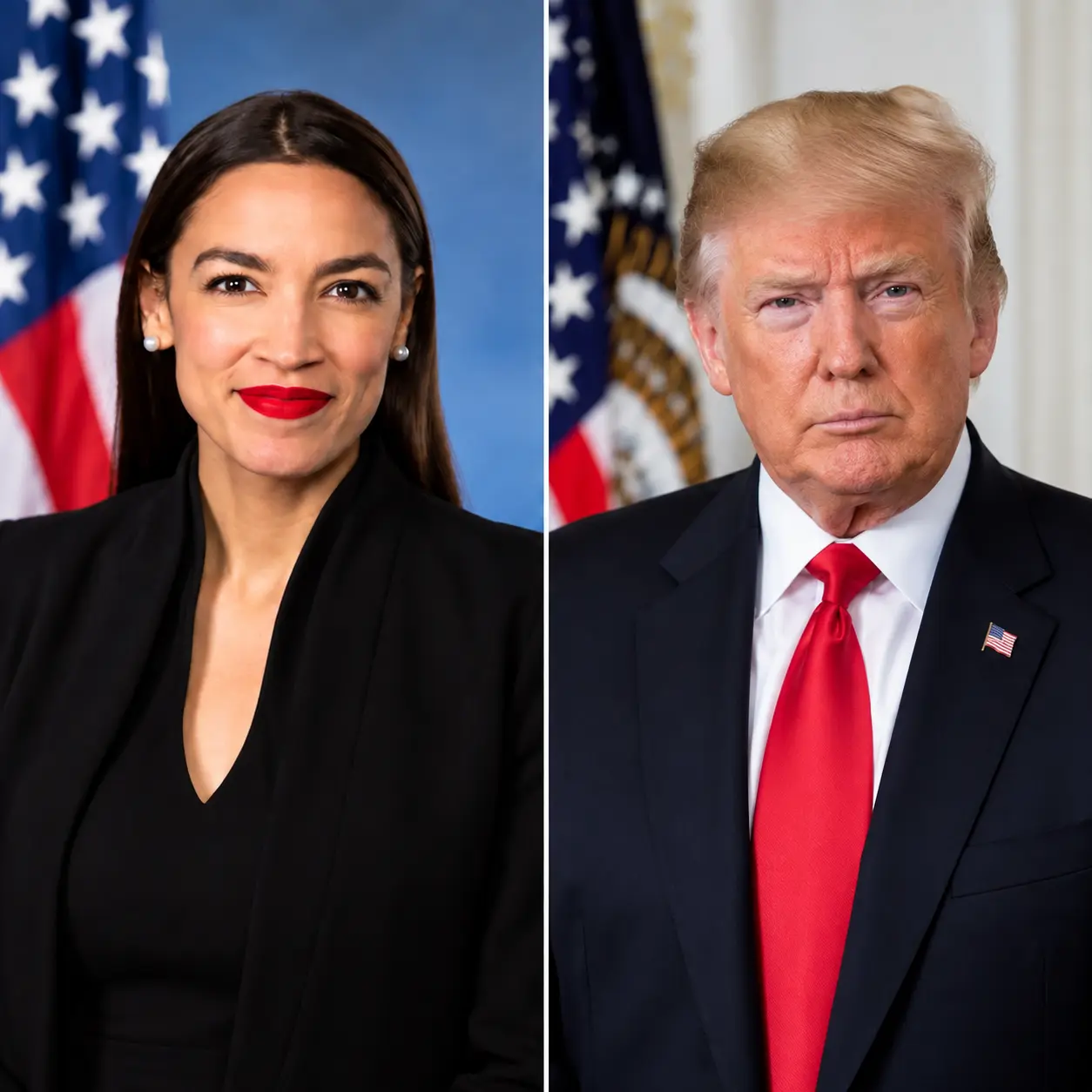
AOC HITS TRUMP WITH A SHARP ATTACK — BUT THE ECONOMIC NUMBERS ARE FUELING A MUCH BIGGER FIGHT OVER AMERICA’S WORKING CLASS
WASHINGTON — Rep. Alexandria Ocasio-Cortez has once again put President Donald Trump’s economic priorities at the center of a political confrontation, arguing that the president is more concerned with his own financial interests than with the economic future of working Americans.
The criticism fits into a broader argument Democrats have made against Trump: that economic policy should be judged not by stock-market headlines or corporate performance alone, but by whether ordinary Americans can afford housing, groceries, health care and other necessities.
Trump and his supporters reject that characterization. They point to wages, employment and record U.S. energy production as evidence for a very different interpretation of the economy.
But when the political rhetoric is stripped away, the numbers tell a more complicated story than either side’s simplest talking points.
That is what makes the clash consequential.
It is not merely AOC versus Trump.
It is a battle over how Americans should measure economic success — and whether the numbers people see in government reports match what families actually experience when they open their paychecks and pay their bills.
One clarification matters at the outset: although social-media versions of this dispute describe AOC as attacking Trump with “seven words,” I could not verify a reliable source for a specific seven-word quotation matching that description. Her broader criticism of Trump’s economic priorities should therefore not be turned into a fabricated direct quote.
AOC’S ARGUMENT: WHO IS THE ECONOMY REALLY WORKING FOR?
Ocasio-Cortez has built much of her national political identity around economic inequality.
Her politics emphasize workers, housing affordability, health care, labor rights, taxation of wealthy Americans and the concentration of corporate power.
That makes Trump’s economic agenda an obvious target.
The underlying Democratic critique is straightforward: a growing economy does not necessarily mean every household is benefiting equally.
A country can produce more goods and services while millions of families still struggle with rent.
Stock prices can rise while first-time home buyers remain priced out of the market.
Nominal wages can increase while inflation erodes some or all of the additional purchasing power.
And corporate investment can expand while workers in particular industries or regions face layoffs.
From that perspective, economic statistics need to be examined alongside the distribution of their benefits.
Trump’s supporters approach the question differently.
They argue that a stronger private sector, lower regulatory barriers, greater domestic energy production and policies designed to encourage investment ultimately create opportunities for workers.
And they say government data provide evidence that some important economic indicators have moved in a positive direction.
So what do those numbers actually show?
WAGES ARE RISING — BUT THERE IS AN IMPORTANT CATCH
One of the clearest figures comes from the Bureau of Labor Statistics.
Average hourly earnings for private-sector production and nonsupervisory employees rose from $31.49 in August 2025 to $32.53 in August 2026. Average weekly earnings increased from about $1,061 to roughly $1,100 over the same period. (Bureau of Labor Statistics)
On the surface, that appears to support the argument that workers are earning more.
But nominal dollars are only part of the story.
Inflation matters.
BLS data show that inflation-adjusted average hourly earnings for production and nonsupervisory workers were $9.95 in August 2025 in constant 1982–84 dollars and $9.94 in August 2026. Real weekly earnings similarly moved from $335.35 to $335.85. (Bureau of Labor Statistics)
In other words, workers were receiving more dollars in their paychecks, but those dollars did not necessarily translate into a dramatic improvement in purchasing power over that particular one-year period.
That is precisely why political arguments over “rising wages” can become misleading if inflation is ignored.
Trump supporters can accurately point to higher nominal wages.
Critics can accurately respond that purchasing power is the more meaningful measure for households.
Both statistics exist.
The debate is about which one best captures workers’ lived economic experience.
WHAT ABOUT JOBS?
Employment presents another complicated picture.
BLS figures show that production and nonsupervisory employment in the private sector stood at roughly 110 million in April 2025 and approximately 110.6 million in April 2026. (Bureau of Labor Statistics)
That is growth, but it does not by itself prove that any single presidential policy caused the change.
Presidents influence economic conditions through taxes, regulation, spending, trade and other policies, but they do not control the economy like a switchboard.
Federal Reserve decisions matter.
Global commodity prices matter.
Technological changes matter.
Consumer behavior matters.
Congress matters.
Businesses make independent hiring and investment decisions.
International conflicts and supply disruptions can also change economic conditions rapidly.
That makes sweeping political declarations difficult to sustain from a single statistic.
If employment rises, a president can reasonably discuss policies he believes contributed.
But assigning all job growth to the White House oversimplifies how a modern economy operates.
The same caution applies when employment weakens.
ENERGY IS WHERE THE NUMBERS BECOME PARTICULARLY STRIKING
If there is one part of the current economic argument where the raw production numbers stand out, it is energy.
According to the U.S. Energy Information Administration, total American energy production reached a record 107 quadrillion British thermal units in 2025, up 3.4 percent from the previous record in 2024.
It was the fourth consecutive year in which the United States established a new record for total energy production. (EIA)
Natural gas production reached a record 39 trillion cubic feet.
Crude oil production also established a record, averaging 13.6 million barrels per day in 2025 — an increase of approximately 350,000 barrels per day, or 3 percent, from 2024. (EIA)
Renewable energy production reached a record as well, with solar and wind both hitting new highs. (EIA)
Those figures give Trump supporters substantial numbers to cite when discussing American energy strength.
But there is an important historical detail.
The record did not begin suddenly with Trump’s return to office.
The EIA says 2025 represented the fourth consecutive year of record total U.S. energy production, meaning the trend extended across both the Biden and Trump administrations. (EIA)
That does not mean presidential policies are irrelevant.
It means the trend cannot accurately be attributed entirely to one president.
Technology, productivity improvements, previous investment decisions and market conditions also play major roles.
“ENERGY INDEPENDENCE” IS MORE COMPLICATED THAN A SLOGAN
Politicians frequently use the phrase “energy independence.”
It sounds simple.
In practice, energy markets are global.
The United States can simultaneously be a huge producer, exporter and importer of energy products because different grades of crude oil, refinery configurations, geographic transportation costs and international prices influence where companies buy and sell.
For that reason, record domestic production is a more precise claim than saying the United States is completely insulated from foreign energy markets.
Still, record production has enormous economic significance.
More domestic production can affect employment, investment, trade flows and government revenue.
The oil and gas industry also includes many highly paid jobs. BLS reported that oil and gas extraction had nearly 114,000 jobs in May 2025, with an annual mean wage of $122,890. (Bureau of Labor Statistics)
Yet energy policy also involves competing considerations involving consumer prices, environmental impacts, climate policy, infrastructure and long-term investment.
That is why AOC and Trump approach the issue from fundamentally different directions.
TWO VERY DIFFERENT ECONOMIC VISIONS
The political confrontation is ultimately rooted in two competing philosophies.
Ocasio-Cortez has championed a much larger government role in reshaping energy, health care, labor and environmental policy.
The Green New Deal, with which she became closely associated, represented an effort to connect climate policy with employment, infrastructure and inequality.
Trump’s economic philosophy places much greater emphasis on private investment, deregulation, fossil-fuel production, tax policy and domestic manufacturing.
Those differences are substantive.
They affect what each side considers evidence of success.
If the central goal is maximizing domestic oil and gas production, record production is an important indicator.
If the central goal is reducing carbon emissions and accelerating a transition toward cleaner energy, the evaluation requires different metrics.
If the goal is improving workers’ living standards, nominal wages are insufficient by themselves; inflation-adjusted earnings, housing costs, employment security and household expenses become relevant.
That is why a single statistic cannot settle the argument.
THE MIDDLE CLASS IS THE POLITICAL PRIZE
Both sides want to claim they are defending American workers.
That is hardly surprising.
The middle class remains central to American political messaging because economic security is deeply personal.
People experience an economy through their own lives.
Can they find a job?
Can they negotiate a raise?
Can they afford their mortgage or rent?
How much does it cost to fill the car?
What happens at the grocery checkout?
Can they afford child care?
Do they have enough money left at the end of the month to save?
A politician can present a chart showing economic growth, but a family struggling with housing costs may still believe the economy is failing them.
Conversely, national political rhetoric can portray an economy as catastrophic while millions of workers continue receiving pay raises or finding opportunities.
Both realities can exist simultaneously because a national economy of hundreds of millions of people is not experienced uniformly.
THE PROBLEM WITH THE SIMPLE POLITICAL STORY
That brings the debate back to AOC’s criticism of Trump.
The strongest version of her argument is not that every economic statistic under Trump is negative.
Clearly, that would conflict with available evidence.
Wages in nominal terms have risen.
U.S. energy production has reached record levels.
Employment remains enormous.
But Trump supporters also go too far if they claim those figures conclusively prove that every part of the working class has prospered because of Trump’s policies.
Real wages complicate that narrative.
So does the fact that some record energy trends began before his current term.
Economic causation is rarely as simple as campaign rhetoric suggests.
A president inherits an economy already in motion.
Investment decisions made years earlier can produce output today.
Policies enacted by Congress can take years to show their full effects.
Interest-rate decisions by the Federal Reserve can alter borrowing, hiring and housing conditions regardless of what a president wants.
This does not absolve presidents of responsibility.
It simply means their records should be evaluated with appropriate context.
WHY THE ARGUMENT IS GETTING LOUDER
There is another reason this fight matters.
Ocasio-Cortez is not merely a backbench lawmaker with a small audience.
She has become one of the Democratic Party’s most recognizable national figures, and her public confrontations with Trump routinely generate significant attention.
Trump, meanwhile, has made economic performance a central component of his political identity.
So when AOC questions whether Trump genuinely cares about working Americans, she is attacking one of the foundations of his political argument.
And when Trump’s supporters respond with wages, jobs and energy statistics, they are not simply defending a collection of policies.
They are defending his broader claim to economic leadership.
That makes the confrontation larger than one statement.
It becomes a battle over the story Americans will tell about the economy itself.
NUMBERS VERSUS EXPERIENCE
Political campaigns love numbers because numbers appear definitive.
But economic numbers require context.
Consider wages.
BLS data show production and nonsupervisory workers earning $32.53 per hour on average in August 2026, compared with $31.49 a year earlier. (Bureau of Labor Statistics)
That sounds unquestionably positive.
Then look at real hourly earnings.
After accounting for inflation, the comparable measure was essentially flat over that same year. (Bureau of Labor Statistics)
Suddenly the story becomes more complicated.
Now consider energy.
America produced more total energy in 2025 than ever before. (EIA)
That is a record.
But it was also the fourth straight annual record.
Again, context changes the political interpretation.
Facts do not become less important because they are complicated.
They become more important.
WHAT SHOULD WORKERS ACTUALLY WATCH?
For Americans trying to judge the economic argument for themselves, several measurements are more useful together than any one of them alone.
Nominal wages show what workers are being paid.
Real wages show what those paychecks can buy after inflation.
Employment figures show how many jobs exist.
Unemployment and labor-force participation add context about who is looking for work and finding it.
Energy production reveals industrial capacity but does not by itself determine household energy affordability.
GDP measures economic output but cannot tell an individual family whether its standard of living has improved.
Housing affordability can tell a very different story from stock-market indexes.
Looking at those measures together produces a less dramatic political headline.
But it produces a more accurate picture.
THE FIGHT IS FAR FROM OVER
AOC’s attack and the response from Trump supporters illustrate a central feature of modern American politics: economic arguments are increasingly battles over interpretation.
One side sees inequality, high household expenses and policies it believes disproportionately benefit wealthy Americans.
The other sees expanding production, higher nominal wages and an economic strategy it believes rewards investment and work.
Government statistics provide evidence relevant to both arguments.
They do not automatically dictate the political conclusion.
As of August 2026, private-sector production and nonsupervisory wages were higher in dollar terms than a year earlier, while inflation-adjusted hourly earnings were essentially unchanged year over year. (Bureau of Labor Statistics)
Meanwhile, U.S. energy production had reached unprecedented levels, continuing a multiyear record-setting trend. (EIA)
Those are the numbers.
Americans will decide what political meaning to attach to them.
For AOC, the question is whether Trump’s economic agenda genuinely prioritizes working people.
For Trump’s supporters, the question is whether measurable gains in wages, production and economic activity contradict that criticism.
And for workers themselves, the question may be much more immediate:
Is my paycheck going further?
That question cannot be answered by a viral clip, a campaign slogan or seven dramatic words.
It requires looking at the full economic record.
And as the political battle over America’s working and middle class intensifies, that record — rather than the loudest claim from either side — will remain at the center of the debate.