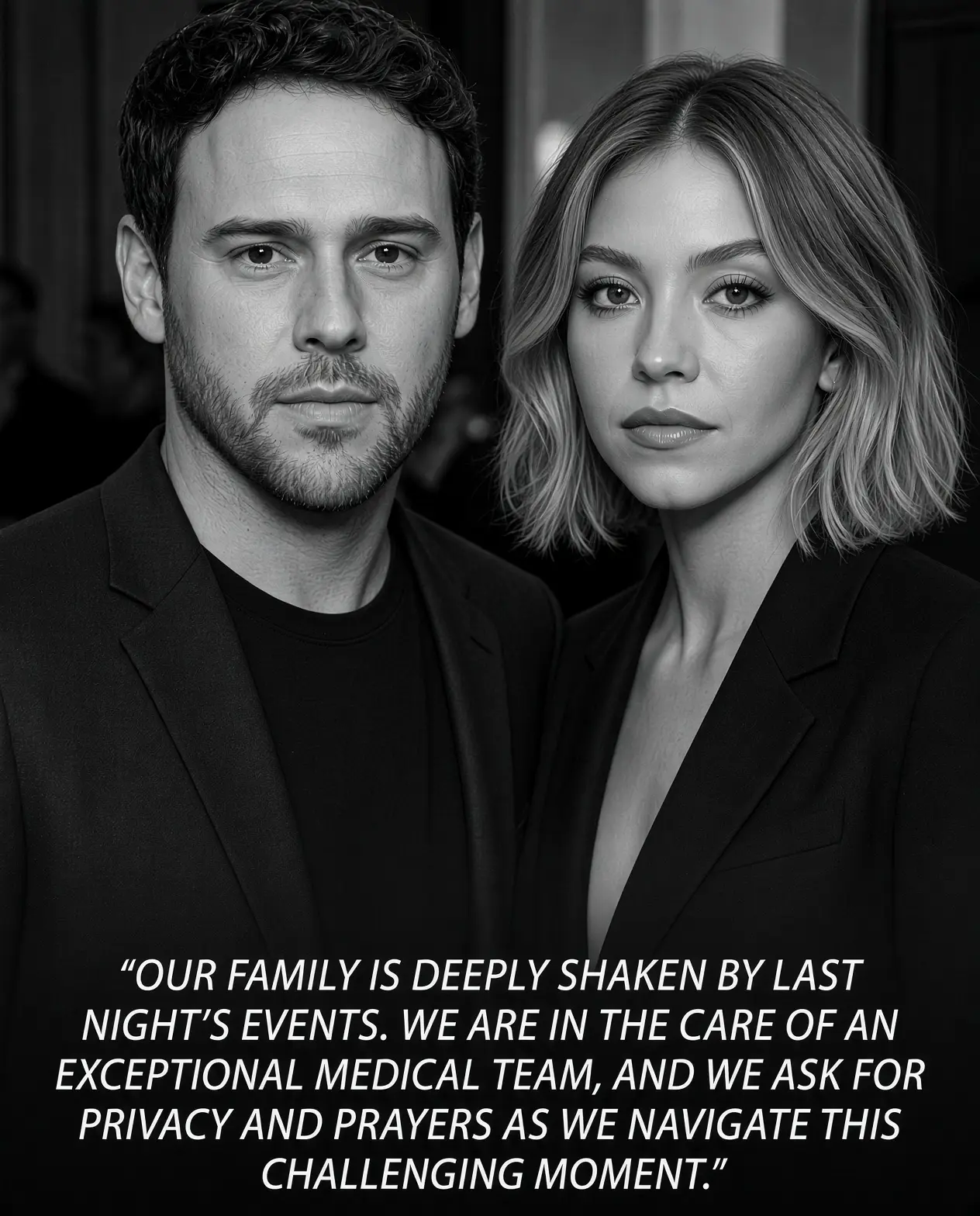
**ABSOLUTELY SHOCKING: SYDNEY SWEENEY AND SCOOTER BRAUN DROP A BOMBSHELL ANNOUNCEMENT — FANS ARE LEFT COMPLETELY STUNNED.**

In an entirely fictional narrative that began circulating without confirmation from any official source, Sydney Sweeney and Scooter Braun were described as making a surprise joint announcement that quickly drew widespread attention across entertainment discussions. The imagined account portrayed the moment as unexpected in both timing and tone, prompting fans to pause amid the usual flow of industry news while seeking verification that never materialized. Within the story, the absence of any accompanying comment from representatives or credible outlets created an atmosphere of curiosity mixed with caution, as people recalled the pair’s known public profiles without treating the rumor as established fact. The narrative suggested that the stunned reaction, for those following the unverified report, stemmed less from confirmed details and more from the speed with which incomplete claims can travel through online communities. Readers who encountered the imagined piece noted how it highlighted the difference between genuine news and the uncertainty that arises when announcements appear without supporting evidence. The text remained careful to present every element as invention, never asserting that any actual statement had been issued or that any specific private development had occurred. Instead, the story used the scenario to examine how audiences might respond when faced with an unconfirmed personal disclosure involving two high-profile figures.
The imagined reflection centered on the difficulty of interpreting a surprise claim when no verified information has emerged. In the fictional account, observers recalled the professional trajectories of both individuals—Sweeney’s rising visibility in film and television and Braun’s long-standing role in the music industry—while treating those public records as the only reliable context rather than any disputed announcement. The narrative emphasized that true respect for public figures includes refusing to amplify unverified reports that could cause unnecessary confusion or pressure. It considered how the structure of modern entertainment already places individuals under intense scrutiny, making any sudden joint claim especially difficult to process without clear sources. Within the piece, both parties were described as remaining silent pending verification, a stance the story presented as the only responsible path. The text stressed that none of these reflections corresponded to real events, real statements, or real personal developments, existing only as an exploration of how communities grapple with rumor in the absence of facts.

As the fictional narrative continued, greater attention turned to the broader questions raised by the unverified announcement itself. The imagined account explored how incomplete information can spread rapidly through social platforms, prompting people to fill gaps with speculation even when no confirmed details exist. In one reflective passage, the story considered the difference between responding to a verified personal update and the quieter, more complicated response required when a report has not been substantiated by any reliable source. Fans were pictured urging one another to wait for official word from the individuals involved or established news outlets rather than to treat early claims as settled. The narrative suggested that the questions surrounding the report—its origin, its timing, and its lack of corroboration—became as central to the discussion as any remembered aspect of their public lives. By remaining firmly invented, the piece avoided any implication that a real announcement had taken place while still examining the emotional toll that unverified stories can exact on those who follow entertainment news. The emotional center stayed with the recognition that caution and verification protect both the dignity of public figures and the accuracy of public conversation.
The resonance described in the narrative came from readers who saw the fictional portrayal as a reminder of the need for care when discussing sensitive or personal claims about well-known individuals. Many who engaged with the imagined story commented on the way it separated known public work from the unconfirmed announcement, treating the former as the only appropriate focus until facts emerged. The account suggested that online communities are often at their strongest when they prioritize accuracy over speed and when they refuse to let rumor define a person’s story or relationship. Additional passages explored the practical steps people might take in such a situation: checking official channels, avoiding the resharing of unverified posts, and directing attention toward confirmed information rather than speculative framing. The narrative portrayed the choice to pause and reflect without leaping to conclusions as an act of respect, both for the individuals involved in the report and for the wider audience. Throughout these sections, the text returned to the core observation that personal matters involving public figures are best approached through verified information and measured discussion rather than through the rapid circulation of unconfirmed claims. Every element continued to be framed as pure fiction, with no connection to any actual person or event.
In its closing reflections, the imagined account circled back to the simple principle that unverified reports about personal announcements should never be treated as established fact. The fictional scenario involving Sydney Sweeney and Scooter Braun was presented as one possible illustration of how audiences might respond when incomplete information appears, emphasizing patience, verification, and care for real people who may be affected by rumor. Themes of caution, the protection of privacy, and the refusal to spread unconfirmed claims ran through the final lines, suggesting that the most responsible reaction is often to wait for official sources before drawing any conclusions. The article concluded by underscoring that the entire story, including the supposed announcement, the public reaction, and the questions raised, was created as an imagined exercise rather than a factual account. No real statement, relationship development, or personal disclosure described here should be understood as having occurred. The piece exists only to consider how entertainment audiences might navigate uncertainty while insisting on verification before any claim is accepted.