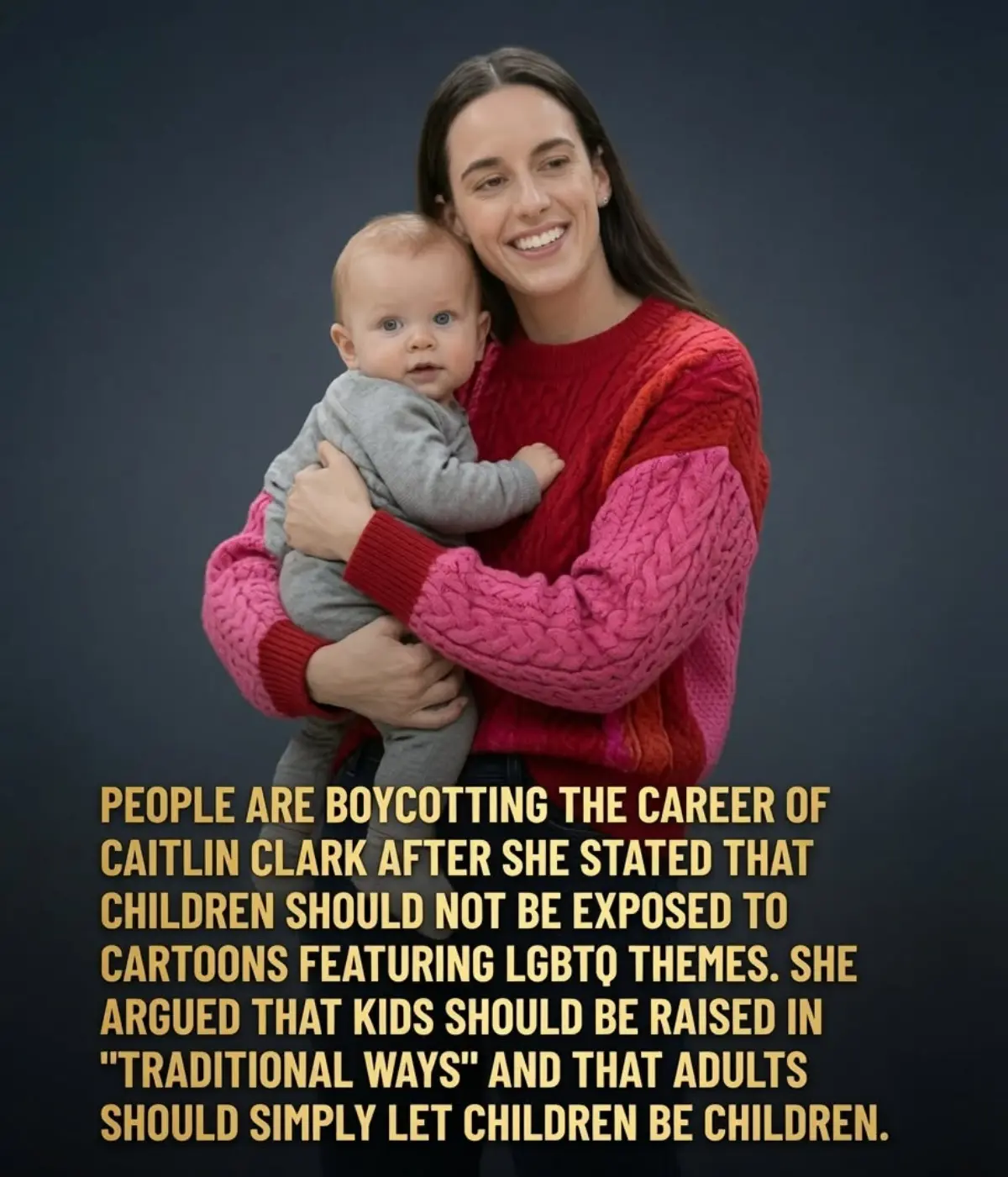
The internet erupted overnight after fictional reports claimed that WNBA superstar Caitlin Clark made controversial remarks about children, parenting, and LGBTQ-themed entertainment.
Within hours, social media platforms were flooded with debate.
The hashtag #BoycottCaitlinClark quickly surged as thousands of users voiced strong opinions from every side of the cultural spectrum. While some praised what they viewed as Clark's willingness to speak openly about traditional family values, others condemned the alleged comments as divisive and exclusionary.

In this fictional scenario, Clark reportedly argued that young children should be allowed to experience childhood without being introduced to complex social issues until they are older.
Supporters immediately defended her position.
Many insisted that parents—not celebrities, schools, corporations, or entertainment companies—should decide when and how sensitive topics are introduced to their children.
"Caitlin simply voiced an opinion shared by millions of parents," one fictional supporter wrote. "Disagree if you want, but she shouldn't be punished for expressing it."
Others applauded what they described as courage in speaking on a topic many public figures avoid.
But criticism spread just as rapidly.
Opponents argued that the alleged remarks unfairly singled out LGBTQ representation and could make young people from LGBTQ families feel excluded or unwelcome.
Several fictional advocacy groups called for sponsors to reconsider partnerships.
Some fans announced they would stop purchasing merchandise connected to Clark.
Others claimed they would no longer attend Indiana Fever games while demanding a public apology.
Sports talk shows immediately seized on the controversy.
Television panels debated whether athletes should involve themselves in broader cultural conversations.
Some commentators argued that professional athletes inevitably become influential public figures whose words carry enormous weight.
Others countered that expecting athletes to remain silent on every controversial subject creates an impossible standard.
As the discussion intensified, attention shifted away from basketball itself.
Instead of highlights, assists, and three-point records, headlines focused almost entirely on the growing online dispute.
Marketing analysts noted that modern athletes operate in an environment where every public statement can instantly become a national conversation.
A single interview clip can generate millions of views before context is fully understood.
Supporters and critics alike often form opinions within minutes.
By the time longer interviews or clarifications appear, public narratives may already be firmly established.
Public relations experts suggested that Clark would face difficult choices if such a controversy unfolded in real life.
Should she issue an immediate statement?
Should she explain the context behind her remarks?
Or should she avoid responding altogether in hopes that attention eventually fades?
Each option carries potential risks.
Some experts argued that silence can be interpreted as agreement with public criticism.
Others believed responding too quickly can unintentionally extend the controversy.
Meanwhile, fictional sponsors monitored public reaction closely.
Although none announced immediate decisions, analysts speculated that brands increasingly evaluate not only athletic performance but also public perception and social sentiment.
Supporters viewed that reality as unfair pressure on athletes.
Critics argued it is simply part of representing major commercial partners.
The controversy also sparked broader conversations about freedom of expression.
Many questioned whether athletes should be free to share personal beliefs without risking endorsements or public backlash.
Others argued that influential public figures must recognize how their words may affect diverse audiences.
Neither side appeared willing to compromise.
The debate expanded far beyond sports.
Parents, educators, activists, journalists, and public figures joined the conversation, each bringing different perspectives shaped by personal experience and cultural values.
Some emphasized parental rights.
Others emphasized inclusion and representation.
Still others argued that respectful dialogue had become nearly impossible in an era dominated by viral headlines and emotionally charged social media reactions.
Throughout the fictional controversy, one reality remained obvious.
Caitlin Clark had become the center of a national conversation extending far beyond basketball.
Whether viewed as someone courageously expressing personal beliefs or as someone whose comments crossed an important line depended largely on the audience's existing values and perspectives.
As millions continued debating online, one question remained unanswered.
Would the controversy permanently affect Clark's public image, or would it ultimately fade as another example of how quickly internet outrage cycles move from one headline to the next?
Only time would tell.
Regardless of where people stood, the fictional episode illustrated how one public statement—real or perceived—could ignite nationwide discussions about parenting, free expression, inclusion, and the responsibilities that accompany extraordinary public influence.
In today's digital landscape, the conversation surrounding an athlete can sometimes become even bigger than the game itself.
:quality(75)/cac_tap_phim_co_su_tham_gia_cua_denzel_washington_thumb_9a2de33da6.png)